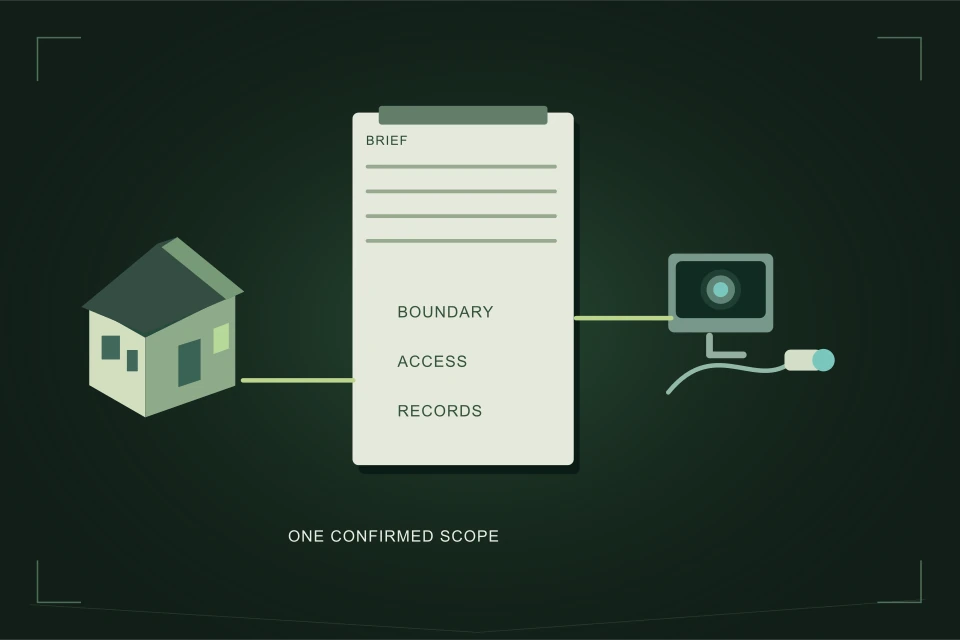
A useful contractor brief identifies the property change, building type, work boundaries, available records and questions still unresolved. Give every bidder the same current information. Ask them to separate investigation, design or approval coordination, installation, restoration and records, with assumptions and exclusions written clearly. The brief requests a scope; it does not direct the technical design.
- Start with the building project, not a predetermined pipe method.
- Send the same plan revision and evidence index to each bidder.
- Separate known work from investigation and conditional allowances.
- State who provides permit, locate, inspection and closeout handoffs.
01 /What belongs in the opening paragraph?
State the civic address, current property, proposed change and stage of design. Identify whether the request concerns an infill house, renovation, suite, subdivision or demolition-related handoff. Describe the outcome without prescribing an unconfirmed solution. “Assess and scope the connection for this proposed renovation” is more useful than “quote a new sewer” when the necessity and limits of replacement have not been established.
Identify the authorized project contact and the person who can provide safe access. Include the plan revision and the desired response: investigation proposal, preliminary scope discussion or construction quotation based on completed records. A contractor should not have to guess whether they are being asked to price missing evidence or to assume that another professional has already resolved it.
If there is a present backup or unsafe condition, describe it separately and seek the appropriate immediate response. A planned redevelopment request should not imply an emergency dispatch was booked. Keep the incident findings with the file so the longer-term scope can address what was actually discovered rather than an initial description made under pressure.
02 /How should the evidence be presented?
Use a short index instead of attaching unrelated files without explanation. For each record, identify its author or source, date, section covered and limitation. Good entries might be a complete private camera run from a stated access point, a current site plan, a City public-service record or an invoice showing a previous spot repair. Each contributes something different to the project.
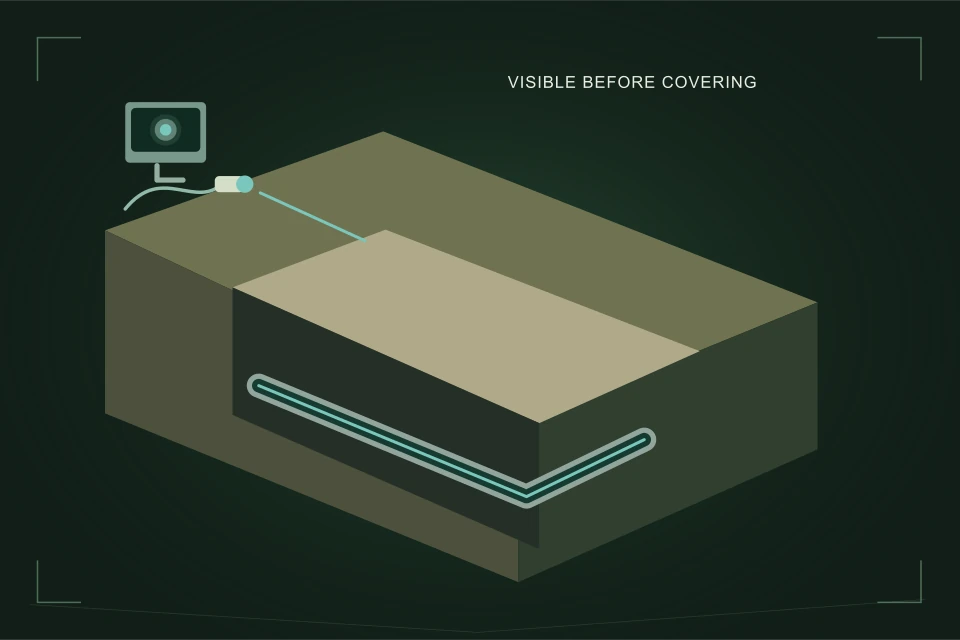
Keep full footage and original documents available. Selected screenshots help a discussion but may omit incomplete reach or obscured areas. A report that recommends work without identifying its inspected section should prompt a clarification before it becomes the basis of a fixed installation scope. The next bidder should see the same relevant evidence rather than a different summary.
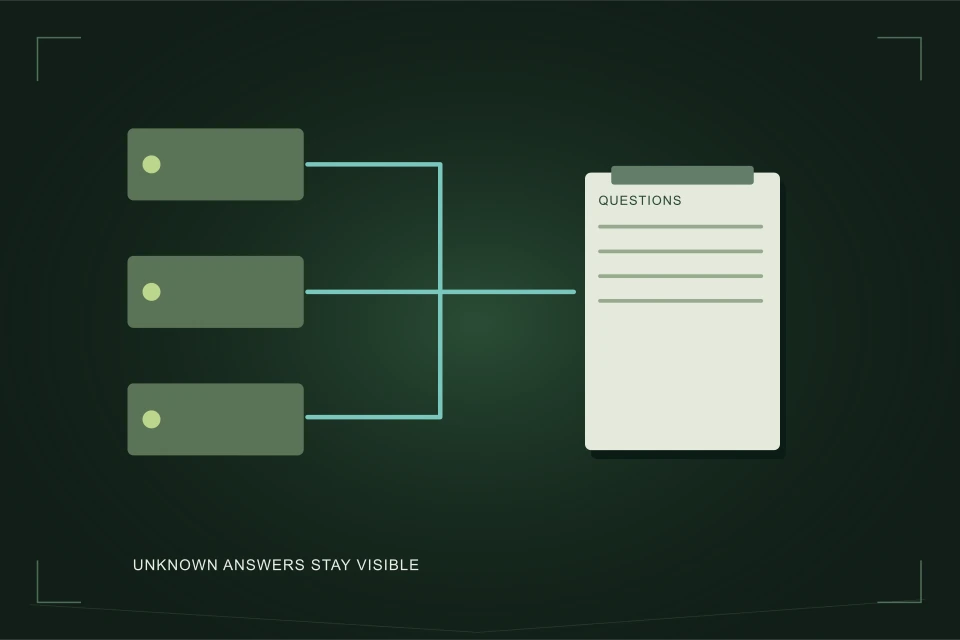
If evidence is missing, put the gap in the index. “Private route not located” and “connection elevation unconfirmed” are actionable statements. Do not complete the file by drawing a plausible route or adding a depth copied from a general article. The contractor can then state what additional investigation is included and how its findings affect the subsequent price.
03 /How do you draw the work boundaries?
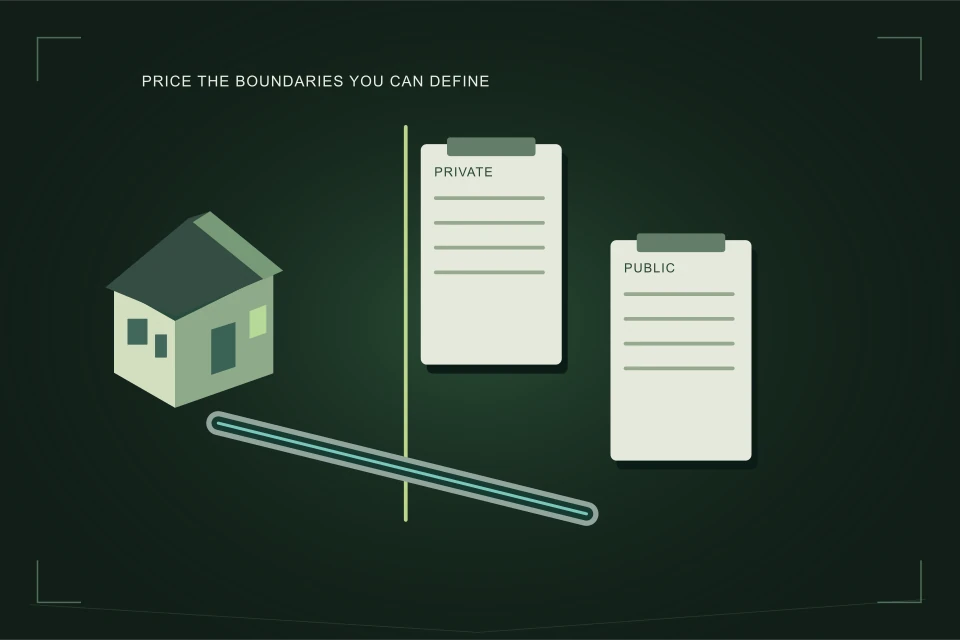
Separate building work, private-lot work and the interface with public infrastructure. Identify new, retained and potentially disconnected sections. Describe existing surfaces and access constraints that have actually been observed, such as a driveway over the investigated route or a retained foundation near the proposed work. Leave unconfirmed details labelled as unknown.
For Calgary, the City’s public dataset describes the main-to-property-line segment and expressly warns that private material and date can differ. The service-connections page addresses owner or builder responsibility for private connections and the public-infrastructure interface. Use those sources to prepare boundary questions, then obtain the project-specific arrangement instead of claiming the diagram decides every exceptional situation.
Where a route crosses another parcel or appears shared, identify the evidence and relevant property question. The brief should not grant access to land the owner does not control or authorize alteration of another building’s service. Assign those permissions and decisions to the appropriate project contacts before they become an assumed construction condition.
04 /Which proposal items should be separated?
| Package | What to describe | Useful clarification |
|---|---|---|
| Investigation | Footage, route, levels or further evidence needed | What question will it resolve? |
| Approvals | Applicable applications and review coordination | Who applies and follows up? |
| Installation | Defined work limits and connections | What assumptions remain? |
| Restoration | Surfaces and temporary versus final work | Who completes it and to what scope? |
| Closeout | Records, media and applicable review evidence | What usable files does the owner receive? |
Separate fixed work from conditional allowances. An allowance for an unknown connection detail should state when it changes and who approves additional work. If two proposals use different assumptions, the comparison is incomplete even when their totals look similar. Ask each bidder to revise against the same evidence or explicitly explain why their approach requires another investigation.
A price request should also identify exclusions. Missing items can legitimately belong to another trade or the builder, but the owner needs an assigned handoff. “By others” should name the responsible party and interface where practical. This matters for permit coordination, public-side work, final surfaces and the document package that follows the installation.
05 /How should scheduling be described honestly?
Distinguish desired timing, proposed sequencing and confirmed appointments. A contractor can describe the order of investigation, approvals, locates, installation and review without promising that every outside party will be ready on a specified date. Ask which dependencies control the start and what information is needed before a booking can be confirmed.
For locates, separate the submitted request from completed responses and private investigations. USP currently warns of high-volume delays, and privately owned facilities require their own arrangement. A date calculated from a routine minimum notice period is not a verified excavation start. The contractor needs to review applicable documentation and current site conditions before proceeding.
For an occupied renovation, add the use and access questions: affected fixtures, planned interruption instructions and communication with occupants. For demolition and infill, identify handoffs between trades. Keep emergency response separate from the construction schedule. The site’s planning tool neither dispatches a provider nor checks their availability.
06 /How do you evaluate the returned scope?
Read it against the project purpose, evidence index and work boundaries. Confirm that the proposal addresses the current plan revision and identifies the same retained or new service sections. Highlight unsupported assumptions, missing investigation and exclusions without an assigned owner. Ask for a clear written response rather than interpreting a broad phrase such as “complete connection” in the most favourable way.
Check that permit, locate, review and documentation responsibilities are explicit. A strong proposal can acknowledge uncertainty and offer a staged investigation instead of presenting a premature fixed construction total. Ask what the first stage will establish, what deliverables it produces and how the later scope will be decided. That is a practical way to buy useful information before committing to an installation.
Use scope comparison to compare what each proposal includes. The Connection Planning Brief prepares a text outline you can edit; its request link only pre-fills a form. Review the actual form, provide contact details and give consent separately when you choose to send a request. No planner answer books work or selects a contractor.
07 /How might a staged request look in practice?
Consider an illustrative redevelopment enquiry with a current site plan and an incomplete private camera run. One bidder prices a full installation assuming replacement; another prices an investigation first. Instead of comparing their totals as competing construction prices, ask both to state what evidence is missing, what their first scope establishes and how the subsequent installation decision will be made. The difference is a purchasing stage, not necessarily a disagreement about the final method.
A useful response might separate camera access, private route investigation, professional review of the proposed interface and a later construction proposal. That list is an example of how to make responsibilities visible, not a required recipe for every property. Ask who receives the evidence and who confirms the next scope. Keep the original request with the investigation deliverables so the final proposal can be traced to findings rather than a different undocumented assumption. This gives the owner a record of the decision as well as a price.
FAQQuestions people ask
Should I choose a pipe method in the request?
State any professional recommendation and its evidence, but do not prescribe an unconfirmed method. Ask the contractor to explain how the proposed connection scope fits the actual project.
Can a bidder quote before all records exist?
They may propose an investigation or conditional scope. Identify missing evidence and the assumptions used, then compare proposals on the same basis.
What does “by others” mean?
It means the bidder excludes that item. Ask who is responsible and what handoff is needed; an excluded item should not become an unassigned project task.
Does adding the brief send a quote request?
No. The link pre-fills the request form. Sending requires a separate review, contact details, consent and submission.
NETWORKGo deeper across the HAUSE Sewer network
What a good sewer inspection report contains
What a sewer inspection report should include: full video, distances, locate and depth marks, a line map and clear limits. A checklist to judge any report.
SewerQuotes.comHow to compare sewer quotes line by line
How to compare sewer quotes: a line-by-line worksheet to normalise scope, spot missing items, convert to per-metre cost and choose between three contractor quotes.
SewerCleaners.caCondo and multi-family sewer cleaning programs
How condo boards build a sewer cleaning program: stack cleaning, building drains, camera baselines, reserve fund planning, bylaws and resident notices.