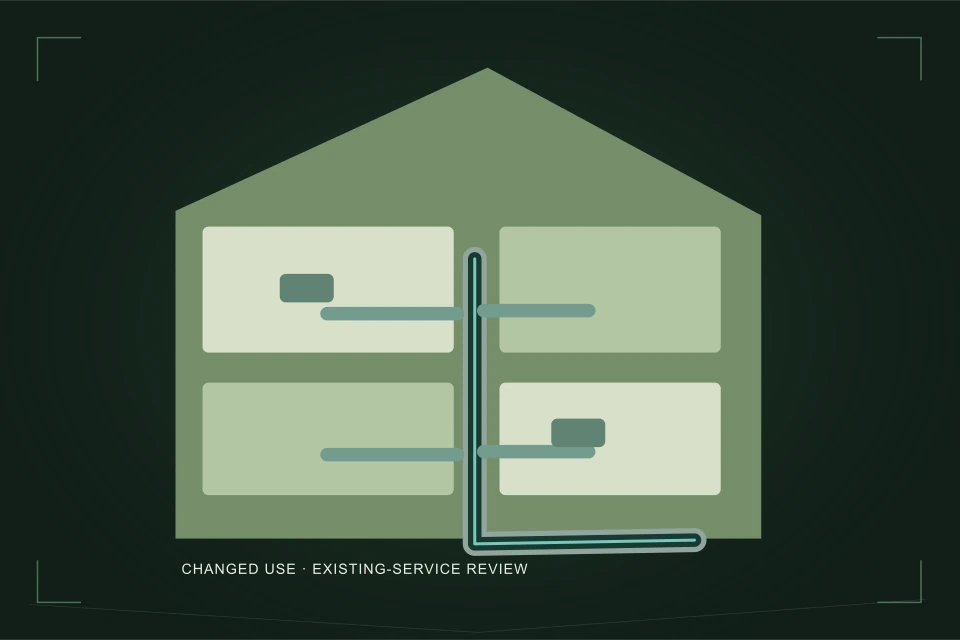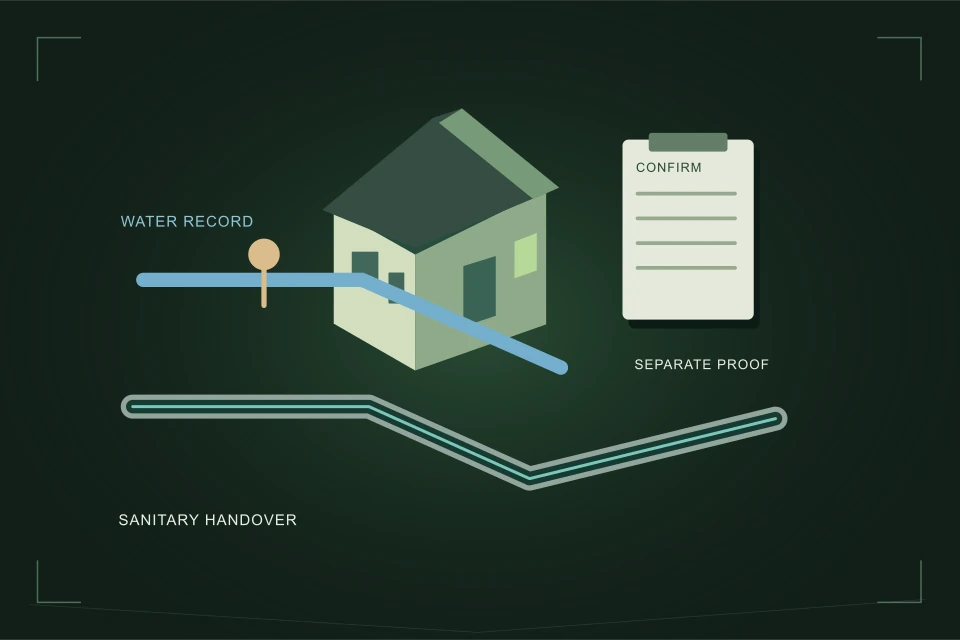
Demolition planning needs an explicit utility-disconnection handoff, with water and sanitary work identified separately. Calgary’s current water page describes shutoff and permanent water-service requirements and directs demolition enquiries to 311. Obtain the project-specific sanitary disconnection or reuse arrangement from the City and qualified team; a water shutoff receipt does not document what happened to the sewer.
- Temporary water shutoff and permanent disconnection are different operations.
- Calgary’s water-service instructions do not establish every sanitary detail.
- Record retained, disconnected and proposed new services separately.
- Resolve the handoff before treating a demolition scope as complete.
01 /What does “utilities disconnected” need to describe?
It needs to identify the utility, operation, work limits and evidence. A water valve turned off for a renovation is not the same thing as a permanent disconnection for demolition. A removed indoor fixture does not describe the treatment of the outside sanitary connection. A contractor’s statement that the site is “ready” should therefore be accompanied by the records relevant to the particular demolition and redevelopment plan.
Make a service register before comparing demolition proposals. List water, sanitary, gas, electricity and other affected facilities as separate entries. State whether each will be temporarily interrupted, permanently disconnected, retained for approved reuse or replaced later. An unresolved decision belongs in the register as unresolved rather than being implied by the general phrase “disconnect all services”.
Calgary’s water-service page says the demolition process is typically initiated by the owner and utilities must be shut off or turned off before the demolition permit is released. For the water service, it describes disconnection at the distribution main, return of the meter and City approval for reuse. Those are water-specific instructions. Confirm the sanitary arrangement separately for the actual project rather than copying the water procedure onto a sewer drawing.
02 /How does a temporary water appointment differ?
The current City page separates single-family or duplex temporary construction and renovation disconnections from demolition or permanent cutoffs. It identifies the Metering Team appointment route for the former and 311 for demolition and commercial or multi-family enquiries. Use the correct current route for the intended operation. An appointment to operate a valve should not be represented in the project log as evidence that all underground services are disconnected.
The City’s water appointment guidance also specifies property-access requirements. Arrange the responsible person and access before the appointment, and retain the appointment or service record with the water entry. The owner’s planning role is coordination, not operating a City valve or altering the service independently. Keep the sanitary entry open until its separate scope and completion evidence are supplied.
Fees and booking details can change, so this guide links to the current City page rather than reproducing a price list. Ask the project coordinator to confirm the intended service and any applicable charges before booking. The budget should distinguish utility appointments, physical disconnection work and later installation rather than treating them as a single unexplained allowance.
03 /Which sanitary questions should be asked before demolition?
Ask what existing sanitary connection is present, which part is being removed or retained, how the relevant interface is documented and who confirms the required arrangement. Ask how a retained route will be protected during demolition and subsequent excavation. If reuse is being considered, identify the evidence needed for that decision and the person responsible for making it.
Do not infer the answer from a public service record alone. Calgary’s dataset covers the City segment and states that private material and installation date may differ. A private camera run, route investigation and relevant project information can be needed to evaluate the owner-side section. A demolished building’s indoor access may disappear, so arrange necessary evidence collection while safe access is still available.
| Question | Useful record | Avoid assuming |
|---|---|---|
| What is present? | Public record plus private investigation | One dataset covers the complete line |
| What is retained? | Defined work limits and assessment | Old drainage proves redevelopment suitability |
| What is disconnected? | Contractor and applicable project records | Water shutoff documents sanitary work |
| What happens next? | Approved project arrangement and scope | A demolition quote includes new services |
04 /How can redevelopment intent change the disconnection brief?
A site remaining vacant and a site immediately entering new construction need different questions about the final condition and later interfaces. State the intended next use when requesting the service enquiry. If the intent changes, revisit the brief rather than assuming the arrangement prepared for the previous programme remains suitable. This guide does not choose the City’s required disconnection method for either situation.
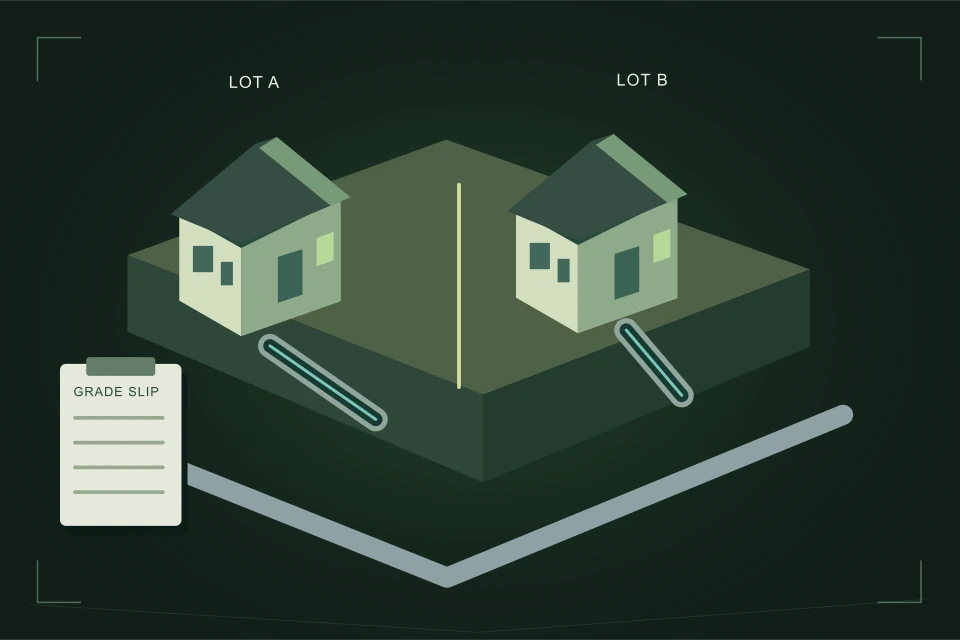
If the future project is a subdivision, coordinate the sanitary questions with the grade slip and parcel records. A connection investigated for one original lot must be reconciled with the proposed lots and building arrangement. Identify any existing route crossing a future boundary and obtain the appropriate project and property review before treating it as a retained shared service.
Keep the design-stage assumptions visible to bidders. A demolition contractor may include making the site safe and removing the old structure but exclude future sanitary installation. A service contractor may price that later installation using a different proposed plan. Both scopes can be reasonable if their limits and interfaces are clear; problems arise when the owner believes each includes the other.
05 /What should the service-disconnection contract include?
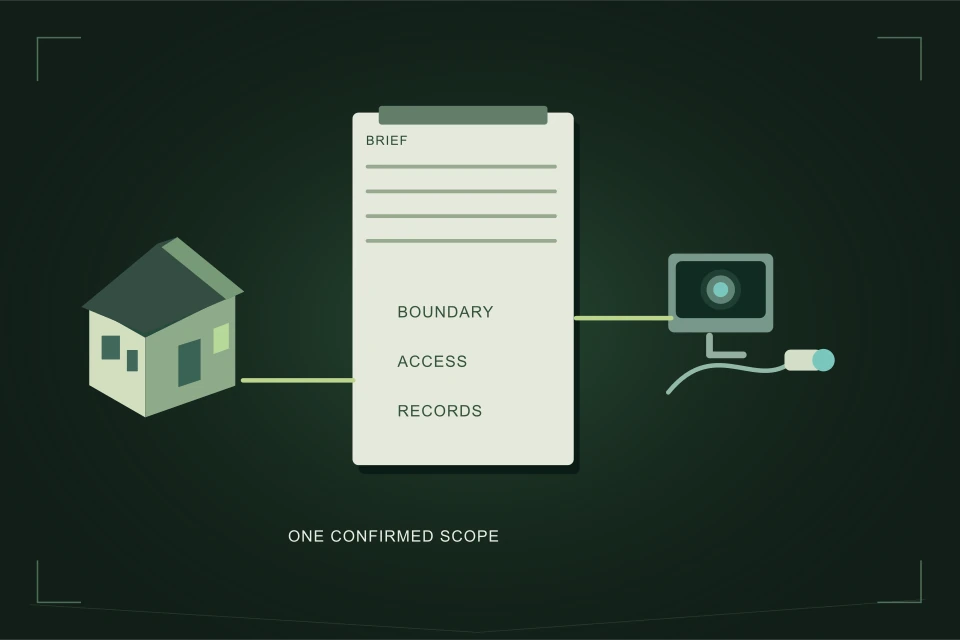
Identify the operation, boundaries, authority or appointment handoffs, access arrangements and records to be delivered. Ask who coordinates each utility, who performs the physical work and who confirms completion for the relevant project process. Include known timing dependencies without representing a planned date as a confirmed appointment. Keep restoration or temporary site-protection responsibilities visible where they affect the next contractor.
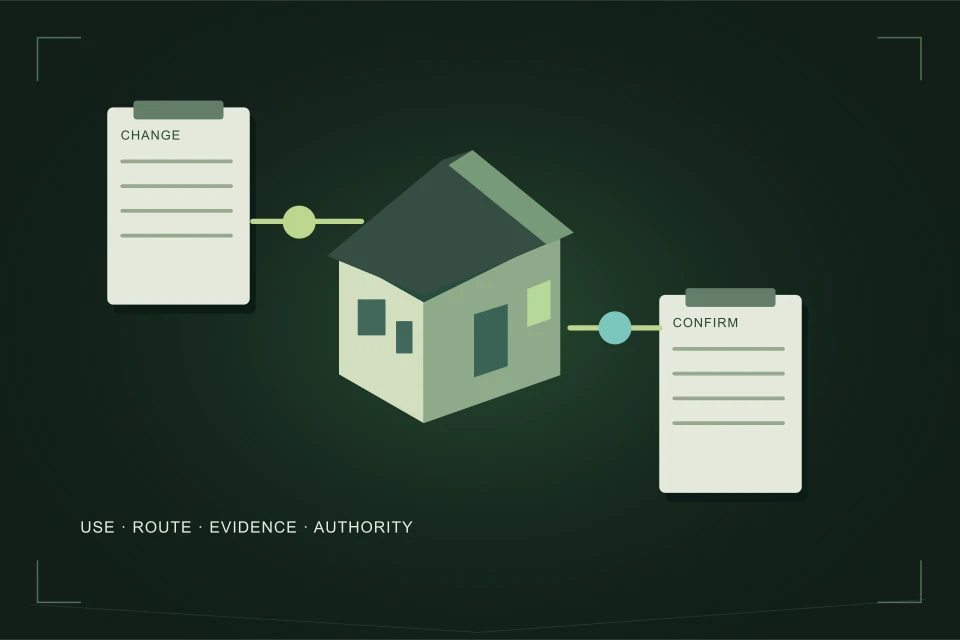
Request a change process for discoveries such as an unrecorded branch, conflicting route or shared connection. The person undertaking safe site work needs a clear project contact when the original assumptions prove incomplete. The owner should receive an explanation and record of the changed scope before it becomes an undocumented extra. Do not use the brief to authorize work on another property or a connection whose rights are unconfirmed.
A sensible closeout identifies what was disconnected, what remains, and what the next trade must know. Images can help if they are dated and related to the site plan. The exact evidence required by the City or other authority should be confirmed through the actual project, not replaced by an arbitrary checklist created by this website.
06 /How do the records reach the next contractor?
Give the new-building or service contractor the final register and underlying evidence before they price against assumed existing conditions. Include the original camera and locating records where relevant, along with the disconnection information. Distinguish old observations from the condition after demolition so the recipient does not treat a pre-demolition route assessment as proof that the line remains unchanged.
Ask recipients to acknowledge what they have reviewed and what additional information they need. A forwarded folder link is useful but does not show that the person responsible for the next installation understood the retained-service limits. Put the current drawing and record index into the connection request so that assumptions can be discussed in writing.
Use the contractor brief guide to connect demolition, investigation and installation scopes. If the sanitary arrangement remains undecided, mark that plainly in the Connection Planning Brief rather than selecting “complete” on the strength of a water appointment. The point is a coherent handoff, not a website-generated clearance to demolish.
07 /How might a two-stage service handoff work?
Consider an illustrative project where demolition and new construction are contracted separately. The demolition proposal says service disconnections are included, while the later installer assumes the previous connection remains available. Before either scope is accepted, ask both parties to identify the actual retained and disconnected sections. Send the current redevelopment plan and obtain the applicable City questions for the intended arrangement. Do not rely on the same broad word meaning the same operation in both contracts.
At the handoff, retain the disconnection records and the installer’s acknowledgement of what remains. If the proposed building or parcel arrangement changes, reopen the relevant connection question. This is a coordination example, not a declaration that a particular service may be reused or a prescribed demolition sequence. Its value is avoiding an invisible gap between two otherwise reasonable scopes.
FAQQuestions people ask
Does turning off the water disconnect the sewer?
No. They are separate systems and records. Obtain a sanitary-specific scope and completion information for the project.
Where does Calgary direct demolition water enquiries?
Its current Water Interruptions and Disconnections page directs demolition and permanent cutoff enquiries to 311. Temporary single-family or duplex construction appointments use the separate route identified there.
Can an existing water service always be reused?
The City’s demolition guidance says water-service reuse requires City approval. That statement should not be used as an automatic decision about sanitary reuse.
What if the demolition quote excludes new services?
Identify the later service scope and who owns the interface. An exclusion is workable when it is explicit and the next contractor receives the actual disconnection and retained-service records.
NETWORKGo deeper across the HAUSE Sewer network
Roots in the main sewer line: is it your lateral or the city's sewer main?
Roots in the main sewer line: how to tell your own lateral from the city sewer main, clues that point to the public side, and who to call first.
SewerCleaners.caHow to hire a sewer cleaner: the checklist, the questions and the paperwork
How to hire a sewer cleaner in Canada: questions to ask, insurance and WCB coverage in Alberta, a written scope template, red flags, and how to compare quotes.
SewerQuotes.comSewer pipe lining cost: what a CIPP liner should cost in Canada
Sewer pipe lining cost in Canada (2026): CIPP liner ranges in CAD for full laterals and single sections, the line items, cost drivers and quality checks.